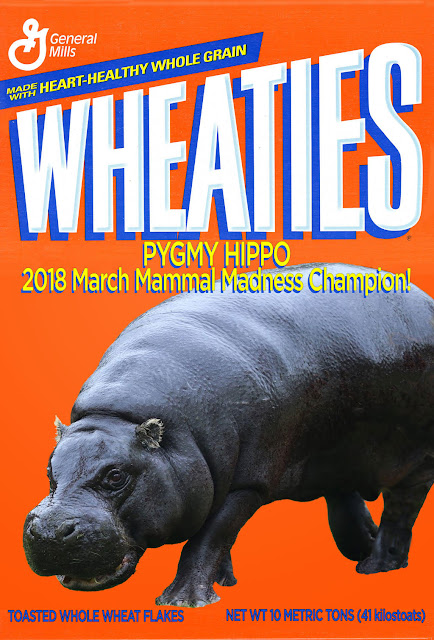
AND THE CHAMPION IS.... (artwork by Princess Pricklepants ) 2nd seed Ambelodon vs 1st seed Pygmy Hippo: EYEING ME, SPYING ME, ROLL OUT! In the final showdown of the tournament we found our combatants in the Cloud Forest of Colombia (specifically the World Heritage designated Los Katios National Park). The forest habitat felt very at home to the Hippo, although some huffing & puffing due to the altitude. Having mostly coasted through the tournament the hippo was in fine fettle and excited to do a relaxing river float. Amebelodon, a relative of modern-day elephants that went extinct ~5 million years ago known as "shovel-tuskers" for their enlarged lower jaw, had a more grueling journey to the championship. With torn muscle from dancing with Doedicurus and a busted trumpet from the wrangle tangle with Orinoco Crocodile, Amebelodon could not risk any further damage over a a resource widely-available in this particular habitat- water. After a staredown-standoff, Amebelodon amb...
Last week was the beginning of our Fall term. Instead of the typical first day of college class, the dreaded and boring Syllabus Day, I decided to finally do something that had been kicking around in the back of my mind for a couple years... I decided to just tell a story. Woodland Grassland (K. Hinde) Welcome to Bones, Stones, and Human Evolution. I am Professor Katie Hinde and I have been studying and researching in this field since 1996. I work in Evolutionary Anthropology and Global Health. You will hear more about me and my work (and the research of our kickass TAs) in the next lecture. But that isn’t the plan for today. Today I am going to tell you a story of humanity. Not “the” story of humanity, because there is no one story of humanity, but a story of humanity. And in doing so, I will tell you a story of Anthropology. I will describe an interrelated set of academic approaches- from paleoanthropology to genetics to primatology to human behavioral ecology to bioarchaeolog...

Comments
Post a Comment